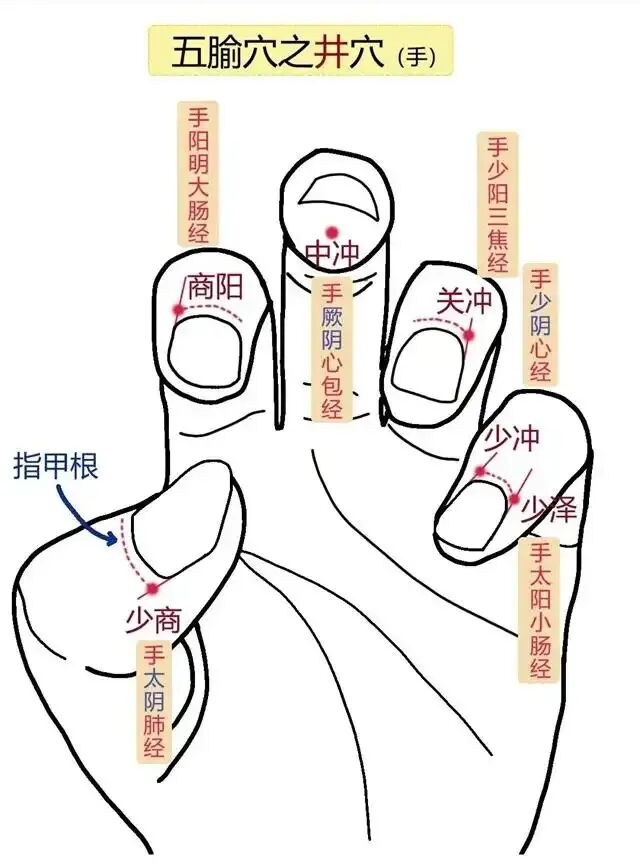
Teacher Ma on the Jing-Well points on the fingers Special thanks to group member [Xingxing] for editing and organizing The human body has twelve main meridians, each of which has a Jing-Well point located at the tips of the fingers or toes. The upper limbs contain six meridians, with their Jing-Well points located at the fingertips: The thumb follows the Lung meridian, and its Jing-Well point is Shaoshang;Adjacent to the Lung meridian is the Large Intestine meridian; the Jing-Well point on the index finger for the Large Intestine meridian is Shangyang;The middle finger is traversed by the Pericardium meridian, and its Jing-Well point is Zhongchong; the Pericardium meridian is paired with the Sanjiao meridian, and the Jing-Well point for the Sanjiao meridian on the ring finger is Guanchong. The inner side of the little finger follows the Heart meridian, with the Jing-Well point being Shaochong, while the outer side follows the Small Intestine meridian, with the Jing-Well point being Shaoze. Zhongchong, Guanchong, and Shaochong all contain the character "Chong" (rush/surge) in their names, representing a healthy state of Qi and blood circulation in those areas, full of vitality. Shaoze is a special point for treating lower back pain; it is also a must-use point for nursing mothers with low milk supply, offering significant results. Stimulating Jing-Well points has many benefits, such as clearing the mind, opening the orifices, and draining heat and toxins; bloodletting at these points can also be used for emergency detoxification. For the procedure, we can use a blood glucose lancet. Although lancets are typically disposable, as long as they are used on the same person and the needle is not bent or damaged, they can be used to prick multiple points on that same individual. How can we accurately locate Jing-Well points? We cannot rely solely on the positions marked on acupuncture charts; the key is to find the "Gao Sheng Dian" (the most reactive point). This is the focus of our study; whether performing bloodletting or acupressure, the primary step is always to locate this reactive point. When searching, you can first gently pinch the area around the point with your fingernail. The Gao Sheng Dian is the spot that feels painful when pressed. Its exact location may vary from person to person, sometimes shifting slightly left, right, inward, or outward. If the point is not located accurately, it will result in insufficient bleeding, making the procedure unnecessarily painful and ineffective. Regarding the pricking, as mentioned earlier, it is best to use a disposable blood glucose lancet. After pricking the first Jing-Well point, be sure to put the cap back on the needle to prevent it from being exposed to the air for too long, and only remove it again when you are ready to prick the next finger point.During the learning process, follow standard procedures; if possible, have alcohol swabs ready for disinfection. If you are outdoors and lack disinfection supplies, simply wiping the area with a tissue is sufficient. If you do not have a lancet, a sewing needle can be used, but it must first be sterilized by burning the tip with fire; in emergency situations, even a safety pin can be used.
🎬 Demonstration of finger Jing-Well point operation
/div>
When pricking the point, hold the needle at a 90-degree angle to the skin to minimize the wound size. The insertion should be quick; just lightly prick the skin at the Jing-Well point. If you push hard as if using an awl, it will not only cause psychological fear but also make a procedure that should be painless feel painful.
Learning TCM Bit by Bit Editorial Department March 3, 2025
Reminder
The above conditioning methods are for reference only and cannot replace professional medical treatment. If self-conditioning does not yield obvious results, it is recommended to seek medical attention promptly to avoid delaying treatment.
END
▲Long press to scan the QR code above,Add WeChat to join the groupEnter the mini-program to discover quality products